
FDA’s salt substitute rule: what R&D and sourcing teams should check before reformulating
Key takeaways
- On October 13, 2026, the FDA published a final rule that allows salt substitutes in 139 standardized foods, including cheeses, bread, canned vegetables, chocolate and mayonnaise. Most changes take effect on December 14, 2026.
- The rule is voluntary, adds no new labeling requirements and does not name approved substitutes. A substitute must be GRAS or an approved food additive and cannot change the food’s basic nature and essential characteristics.
- FDA’s economic analysis puts reformulation costs at $3,000 to $1.5 million per formulation, and minor label changes at $4,269 to $14,679 per UPC.
- For brands that outsource production, the reformulation timeline depends on whether the co-manufacturer and ingredient suppliers can source, trial and validate a substitute in that specific product.
On October 13, 2026, the FDA finalized a rule that lets manufacturers use salt substitutes in 139 standardized foods, a group that includes many cheeses, breads, canned vegetables, condiments and chocolate products. Until now, these foods had a federal recipe standard that required salt or allowed only salt, so a brand that swapped in potassium chloride could lose the right to use the product’s standard name.
The regulatory barrier is gone for most of these foods from December 14, 2026. The work that remains sits largely with manufacturing partners: sourcing the substitute, running pilot batches, testing shelf life and updating labels. This guide covers what the rule allows, where reformulation gets technically difficult and what to confirm with your co-manufacturer before you commit to a timeline.
What the FDA rule changes
The rule lets manufacturers replace some or all of the added salt with a salt substitute in foods whose standard of identity previously required or permitted only salt. According to the Federal Register notice, FDA amended 80 standards directly, and 59 more standards that cross-reference them also now permit substitutes, for a total of 139.
The covered categories include:
- Milk products and cheeses, including sour cream
- Bread, rolls and buns
- Self-rising flour and cornmeal
- Macaroni and noodle products
- Canned fruits, canned vegetables and vegetable juices
- Canned tuna and certain other fish and shellfish
- Chocolate and cacao products
- Margarine, mayonnaise, salad dressings and certain syrups
FDA defines a salt substitute by function: a safe and suitable ingredient, or combination of ingredients, that replaces some or all of the added sodium chloride and performs at least one of salt’s functions in the food. The rule does not list approved substitutes. Potassium chloride appears in the preamble as an example, and the Center for Science in the Public Interest (CSPI) also mentions herbs and spices as options.
Three conditions apply to any substitute:
- It must be GRAS or an approved food additive. The rule does not authorize or exempt any new ingredient.
- It can only be used at the level needed for its purpose.
- It cannot change the food’s “basic nature and essential characteristics.” A cheddar made with a substitute still has to meet the cheddar standard.
FDA does not require a minimum level of sodium reduction for a product to use a substitute.
Key dates
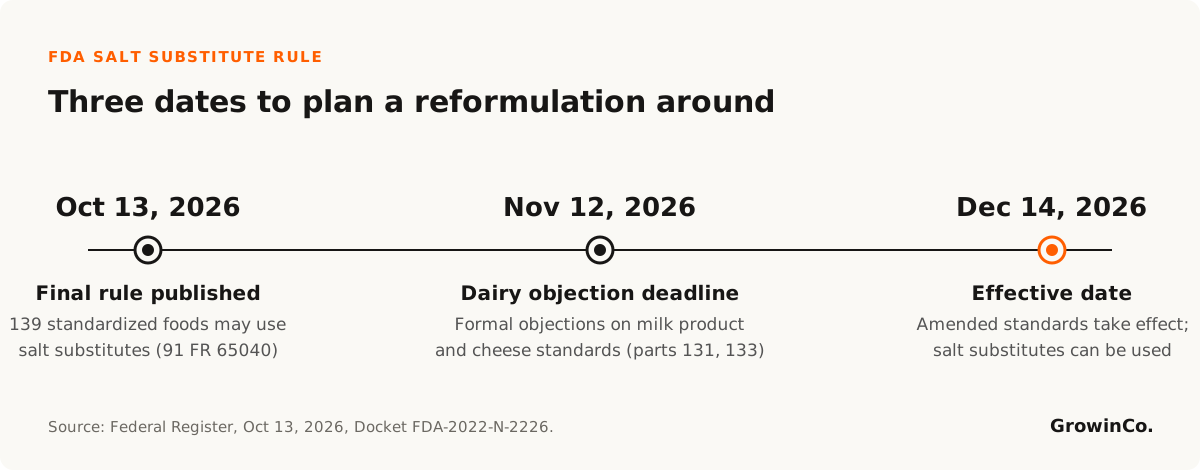
- October 13, 2026: final rule published (91 FR 65040, Docket FDA-2022-N-2226).
- November 12, 2026: deadline for formal objections and hearing requests on the milk product and cheese standards (21 CFR parts 131 and 133), which follow a separate procedure.
- December 14, 2026: effective date for the amendments.
Dairy teams should check the status of the milk and cheese standards after November 12 before locking a launch date, because objections to those standards are handled under a separate procedure.
Why sodium reduction has moved slowly so far
Voluntary sodium targets have produced small changes in packaged food so far, which is part of why FDA removed this barrier. More than 70% of the sodium Americans eat comes from foods with sodium added during manufacturing or commercial preparation, according to the rule.
The gap to the recommended intake is still large:
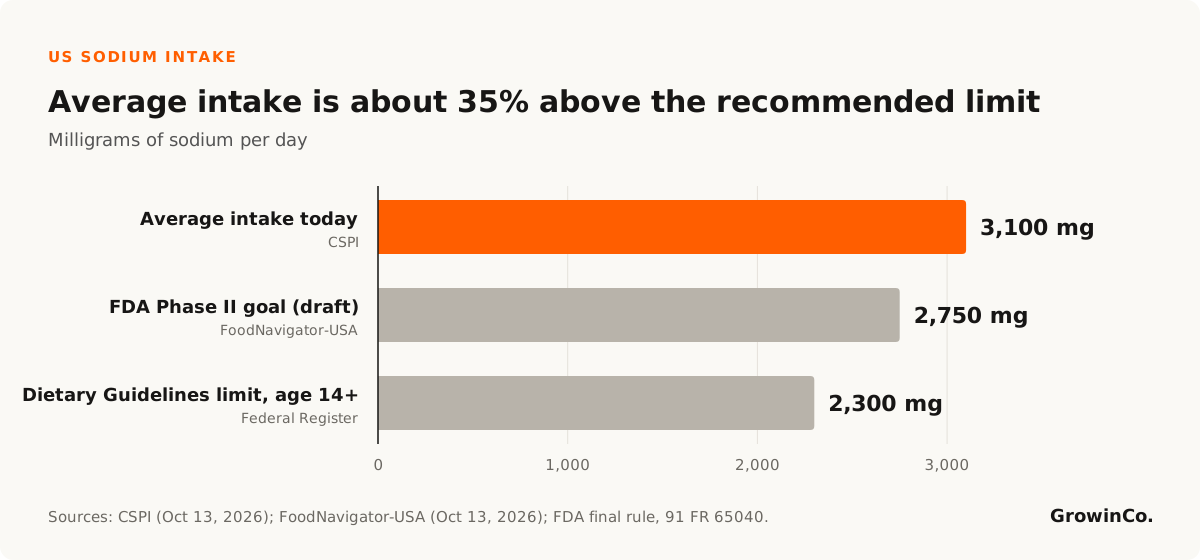
- The Dietary Guidelines set a limit of 2,300 mg of sodium per day for people aged 14 and older.
- Americans consume about 3,100 mg per day on average, roughly 35% above that limit, according to CSPI.
- After FDA’s 2021 voluntary targets, sodium content across food categories fell by a median of 3%, according to CSPI research cited by Food Dive.
- FDA’s draft Phase II targets cover 163 food categories and subcategories and aim to bring average intake to about 2,750 mg per day, according to FoodNavigator-USA.
CSPI has asked FDA to publish a final evaluation of the Phase I targets, issue stronger Phase II targets and finalize front-of-package labeling that includes warnings on high-sodium products. FDA plans a progress report on the Phase I targets later this year, according to FoodNavigator-USA. For brands, that report and any front-of-pack labeling decision are the next dates to watch, because they would change the commercial cost of leaving a high-sodium SKU unchanged.
Where reformulation gets technically difficult
Salt does several jobs in a formula, and a substitute has to cover the jobs that matter in each category. The table below summarizes the functions R&D teams usually need to test for.
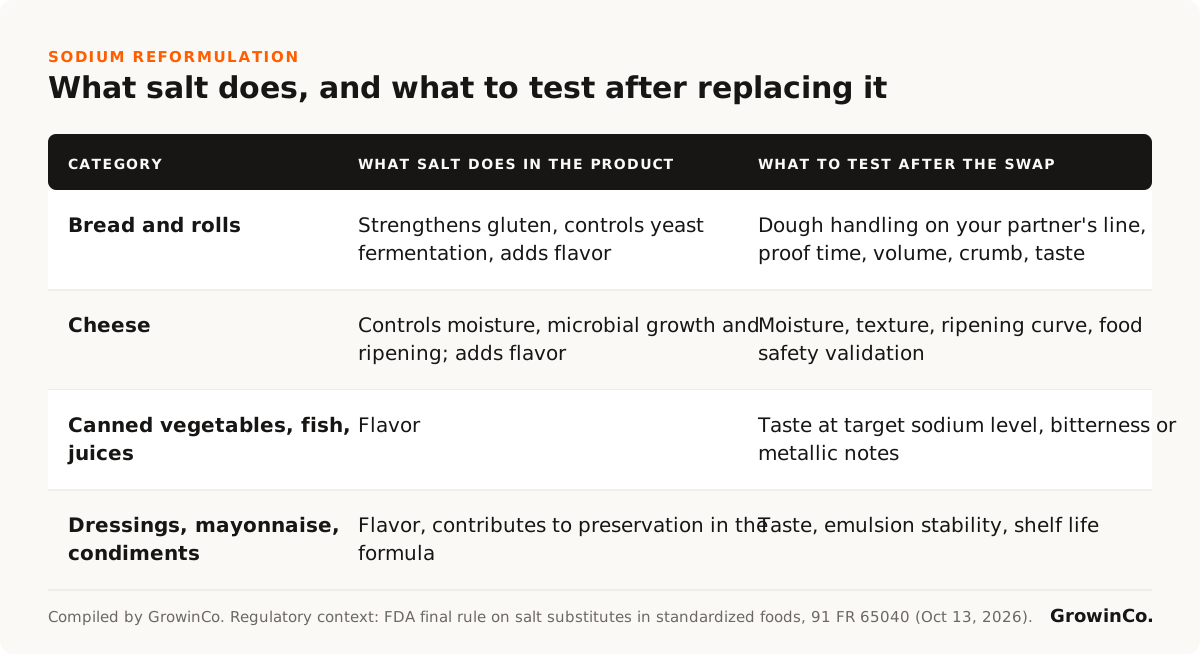
Potassium-based substitutes can bring bitter or metallic notes as replacement levels rise, which is why many projects use blends or partial replacement. Commenters raised concerns about potassium-based ingredients during the rulemaking, according to FoodNavigator-USA.
Labeling also needs a review, even though the rule adds no new requirements:
- Substitutes must appear in the ingredient list by their common or usual name. “Salt substitute” is not an accepted collective name.
- Potassium chloride can be declared as “potassium chloride” or “potassium salt.”
- If the substitute is a blend, any major food allergen in it must be declared.
- Potassium must appear on the Nutrition Facts label when a serving contains 2% or more of the daily value.
Questions to ask your co-manufacturer and ingredient suppliers
Before you commit to a launch date, confirm that your manufacturing partners can run the full reformulation cycle for this specific SKU. These questions cover the points that most often delay a project:
- Ingredient options: Which salt substitutes or blends can your supplier provide, and do they have GRAS documentation or food additive approval for your category?
- Pilot capacity: Does your co-manufacturer have pilot-line or bench time available in the next quarter, and what is the minimum batch size for trials?
- Line compatibility: Will the new formula run on the current line at the same speed, or does it change mixing, proofing, brining or filling parameters?
- Sensory testing: Who runs taste panels, and against which target: the current product, a competitor or a sodium level?
- Shelf life and safety: For products where salt contributes to preservation, who runs the shelf-life study and any food safety validation, and how long does it take?
- Cost per unit: What is the change in ingredient cost per unit, and does it change your contract price?
- Label and packaging: Who updates the ingredient statement and Nutrition Facts panel, and how much existing packaging inventory needs to run out first?
If a partner cannot answer questions 2, 4 and 5 with a name and a date, the reformulation timeline is not yet realistic.
How to budget and sequence the project
FDA’s own cost range shows that budgets depend on product complexity, company size and which salt function you need to replace. The agency estimates $3,000 to $1.5 million per reformulation and $4,269 to $14,679 per UPC for a minor label change. FDA also states it cannot predict how many manufacturers will reformulate, since the rule is voluntary.
A practical sequence for a portfolio with several standardized SKUs:
- Rank SKUs by sodium per serving and by volume. A high-volume SKU with high sodium gives the largest reduction per project.
- Start with flavor-only categories such as canned vegetables, where salt mainly affects taste and the technical risk is lower.
- Plan longer timelines for cheese and bread, where salt affects texture, fermentation or safety and trials take more cycles.
- Align the label change with a planned packaging update so the per-UPC label cost is not paid twice.
- For dairy, wait for the November 12 objection deadline before committing to a launch date.
When to bring in a new manufacturing partner
If your current co-manufacturer does not have pilot capacity, sensory resources or reformulation experience in your category, it can make sense to qualify a second partner for development work. Some brands run trials with a specialized partner and transfer the validated formula to their main production site, which keeps the existing supply agreement in place.
When evaluating a development partner for sodium reduction, check:
- Previous reformulation projects in your category, with a reference you can call
- Access to ingredient suppliers that carry salt substitutes and blends
- In-house or contracted sensory and shelf-life testing
- Certifications your retailers require, such as SQF or BRCGS
- Willingness to sign a formula ownership clause so the validated recipe stays with your brand
Our guide on how to qualify a co-manufacturer before you talk about price covers the full evaluation process.
Find a partner for your reformulation project. GrowinCo’s network of 85,000+ companies includes co-manufacturers, ingredient suppliers and development partners across CPG categories. See how GrowinCo works for brands or book a call to describe your project.